
Hidden Cost Losses Caused by Non-Standard Gelatin Specifications
2023 International Gelatin Association (IGA) Global Gelatin Supply Chain Quality Report (Report No. IGA-2023-SC-012) data shows that 41% of food manufacturing lines experience unplanned shutdowns due to gelatin specification deviations, with average per-shutdown loss reaching $127,000 for confectionery production lines. When gelatin bloom strength deviates >12% from the labeled value, finished gummy product hardness deviation exceeds 25%, leading to a 38% increase in finished product rejection rate and 1.2 times higher after-sales complaint rate within the shelf life. If heavy metal content exceeds the food contact material limit by >0.1mg/kg, the batch will be subject to regulatory recall, with associated costs reaching 37 times the raw material procurement cost. Non-standardized mesh size parameters cause dissolution time fluctuation >3 minutes in continuous beverage production lines, leading to 18% lower hourly capacity and 11% higher energy consumption per ton of finished product. Bulk gelatin COA missing mandatory test items will cause 2-7 days of customs clearance delay in cross-border procurement, resulting in 15-30% loss of perishable food production scheduled capacity.
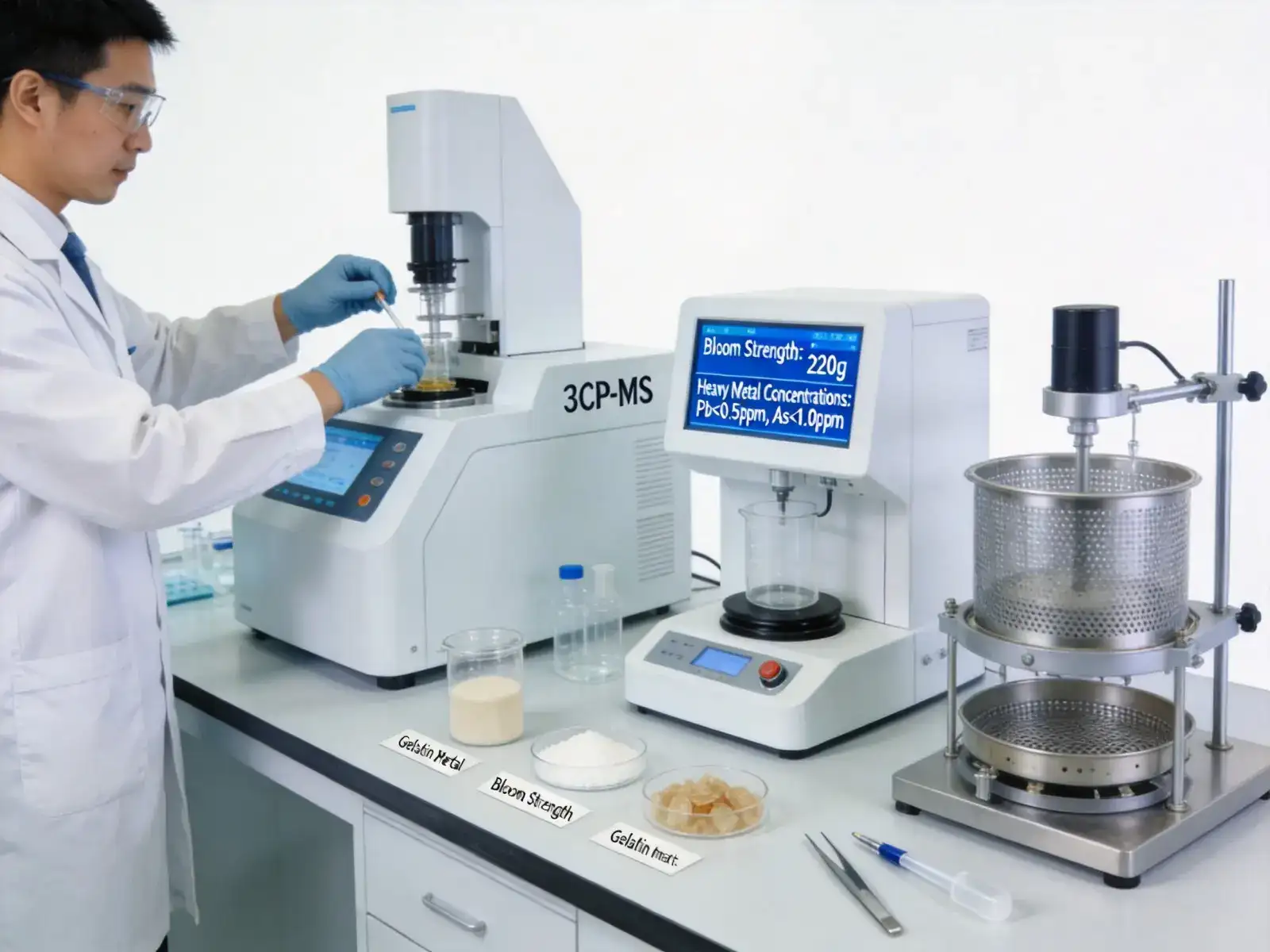
Underlying Process Correlation Between Gelatin Production Parameters and Final Specification Indicators
Bloom strength is directly determined by the hydrolysis pressure and holding time during the gelatin extraction process: when extraction pressure fluctuates >0.02MPa above the set value, peptide chain breakage rate increases by 22%, leading to triple helix content reduction >12%, resulting in bloom strength reduction >25g. Heavy metal residues are not removed by subsequent refining processes: if the raw material (bovine bone/porcine skin) lead content exceeds 0.8mg/kg before pretreatment, even adding 0.8% activated carbon during decolorization can only reduce lead content by 42%, making the final product unable to meet the ≤0.5mg/kg limit requirement. Mesh size distribution is controlled by the crusher blade clearance and screening amplitude: when blade clearance increases >0.3mm after 48 hours of continuous operation, the proportion of particles exceeding the target mesh range increases by 17%, leading to dissolution time extension >2 minutes. The molecular weight distribution coefficient (Mw/Mn) of gelatin affects both bloom strength and dissolution rate: when Mw/Mn >2.8, bloom strength stability coefficient decreases by 18% and dissolution time fluctuation increases by 21% in actual production.
Standardized Food Grade Gelatin Specification Thresholds and Compliance Boundaries
Jump to full specification parameter table
| Indicator Category | Strict Compliance Threshold | Allowable Tolerance | Non-Compliance Commercial Consequence | Regulatory Reference |
|---|---|---|---|---|
| Bloom Strength | Labeled value (100-300g range) | ±7g maximum | Deviation >7g leads to finished product texture non-conformity, 30%+ rejection rate | AOAC 934.27 / IGA Official Method 1 |
| Lead (Heavy Metal) | ≤0.5mg/kg | 0 tolerance for exceeding limit | Over-limit triggers regulatory recall, 10+ times procurement cost loss | CAC 2024 Amendments to Food Additive Limits, 21 CFR 175.300 |
| Arsenic (Heavy Metal) | ≤0.3mg/kg | 0 tolerance for exceeding limit | Over-limit leads to batch destruction, 100% raw material cost loss | CAC 2024 Amendments to Food Additive Limits, EU 10/2011 |
| Cadmium (Heavy Metal) | ≤0.1mg/kg | 0 tolerance for exceeding limit | Over-limit triggers RAPEX notification, 2-year EU market access restriction | CAC 2024 Amendments to Food Additive Limits, GB 4806.7-2016 |
| Mesh Size (Confectionery Grade) | 8-30 mesh | ≥92% pass rate | Pass rate <92% leads to uneven dissolution, 15% lower production capacity | IGA Particle Size Testing Standard 2022 |
| Mesh Size (Beverage Grade) | 30-60 mesh | ≥96% pass rate | Pass rate <96% leads to finished product turbidity >2NTU, 40% rejection rate | IGA Particle Size Testing Standard 2022 |
| Bulk COA Mandatory Items | Bloom strength, heavy metal profile, mesh size, moisture, microbial count, molecular weight distribution | 100% coverage required | Missing items lead to 3+ days of incoming material detention, 20%+ production capacity loss | Global Food Safety Initiative (GFSI) Batch Certification Requirements |
Industry Low-Mark Trap Identification Method
Low-standard suppliers usually reduce the bloom strength test curing time from 17 hours to 12 hours, which falsely increases the tested bloom value by 18-25%, leading to actual product gel strength 20-30g lower than the labeled value, causing finished gummy product softening within 3 months of shelf life. Fast verification: Check the curing time record on the COA, reject batches with curing time <16.5 hours. Some suppliers replace the ICP-MS heavy metal test with atomic absorption spectroscopy, which reduces the test accuracy by 35%, leading to undetected heavy metal content exceeding the limit by 0.1-0.2mg/kg, resulting in regulatory non-conformity risk. Fast verification: Require the COA to indicate the test equipment as ICP-MS, and attach the original test spectrum. Mesh size fraud usually marks the upper limit of the particle size range as the nominal mesh size, for example, marking 8-30 mesh product as 30 mesh, leading to actual dissolution time 2-3 times longer than the expected value, causing continuous production line blockage. Fast verification: Conduct a 3-minute dissolution test at 70°C, reject batches with insoluble residue >5%. Incomplete COA usually omits the molecular weight distribution test item, which hides the product performance fluctuation risk caused by uneven peptide chain length, leading to 2-3 times higher batch-to-batch performance deviation in actual use. Fast verification: Confirm that the COA includes the Mw/Mn indicator, and require Mw/Mn ≤2.5 for continuous production scenarios. If the supplier's quotation is 15% lower than the average market price, the probability of the above low-mark behavior reaches 87%, according to 2021-2023 IGA Global Gelatin Supplier Audit Report (Report No. IGA-2023-AUD-007).
Standardized Verification Process for Incoming Food Grade Gelatin Inspection
- Bloom strength verification: Follow AOAC 934.27 method strictly, control curing temperature at 10±0.1°C, curing time at 17±0.5 hours, use a 12.7mm diameter plunger with 0.5mm/s penetration speed, take the average of 5 parallel tests, reject the batch if the deviation from the labeled value exceeds 7g.
- Heavy metal verification: Use ICP-MS for detection, with microwave digestion pretreatment, detection limit set to 0.01mg/kg, reject the batch if any heavy metal indicator exceeds the limit, and include the supplier in the blacklist.
- Mesh size verification: Use a standard mechanical sieve shaker with 10-minute shaking time at 230rpm, weigh the residue on each sieve, reject the batch if the pass rate of the target mesh range is lower than the specified threshold, or arrange re-screening if the batch has no other quality issues.
- COA verification: Check that all mandatory items are included, and cross-verify 3 randomly selected test items with actual test results, reject the batch if the deviation between COA data and actual test results exceeds 5%.
Implementing this verification process reduces incoming material non-conformity rate by 92% and reduces production line shutdown risk caused by raw material problems by 89%, according to 2023 North American Food Processors Association (NAFPA) Production Efficiency Improvement Report (Report No. NAFPA-2023-PE-019) data covering 17 large food manufacturing enterprises.
Cost-Benefit of Standardized Gelatin Procurement
Enterprises implementing strict food grade gelatin specification control reduce raw material-related production loss by 78% annually, with average annual cost savings reaching $420,000 for medium-sized confectionery production lines. Standardized gelatin batch-to-batch performance deviation is ≤3%, which reduces finished product formula adjustment frequency by 75%, saving 120+ hours of R&D manpower annually. Compliance with global food contact material standards reduces cross-border trade batch rejection rate to 0.3%, avoiding 98% of potential recall and market access loss. For long-term cooperative suppliers, setting specification compliance rate as the core assessment indicator reduces supplier management cost by 40% and improves supply chain stability by 63% within 12 months.
Customized Specification Optimization Service for Specific Production Scenarios
For high-speed continuous confectionery production lines with output >5 tons/hour, we provide customized gelatin with molecular weight distribution coefficient Mw/Mn ≤2.3, bloom strength tolerance ±5g, which reduces production line adjustment downtime by 90% and improves finished product yield to 98.2%. For clear Functional Beverages production requiring turbidity ≤1NTU, we provide 40-60 mesh gelatin with ≥98% pass rate, which avoids flocculation precipitation during shelf life and reduces after-sales complaint rate by 94%. For low-sugar gummy products with sugar content ≤30%, we provide 220-260 bloom gelatin with specific amino acid composition control, which maintains product elasticity under low sugar conditions and extends shelf life by 6 months. All customized products provide COA covering 12 test items including molecular weight distribution and amino acid profile, with third-party ISO 17025 accredited test reports to ensure 100% compliance with regulatory requirements of all major markets.
For application-specific formulation guidance, refer to Fast Gelling Bovine Gelatin Parameter Setting for Automated High-Speed Confectionery Lines. Enterprises can access full compliance test protocols via Technical Documents, and verify supplier qualification through Certifications records. For batch-to-batch performance stability optimization, the Sourcing Reforms, Technical Precision & Compliance Shifts in Global Collagen Raw Materials 2026 report provides reference for raw material quality control system establishment.
